




Why Moisture Control Matters
Microbial Safety and Shelf Life: Excessive moisture creates ideal conditions for mold, yeast, and bacterial growth. These microorganisms not only compromise food safety but also produce off-flavors and accelerate product deterioration. Proper moisture reduction inhibits microbial proliferation, extending shelf life and ensuring products remain safe throughout distribution and storage.
Quality Preservation: Paradoxically, both excessive moisture and over-drying damage spice quality. High moisture levels cause clumping, caking, and color degradation. Conversely, aggressive drying depletes volatile oils responsible for aroma and flavor. The challenge lies in achieving the precise moisture level that ensures stability while preserving sensory characteristics.
Processing Efficiency: Moisture content affects grinding efficiency, blending uniformity, and packaging performance. Overly moist spices clog grinding equipment and create inconsistent particle sizes. Too-dry materials generate excessive dust and experience greater grinding losses. Optimal moisture enables efficient downstream processing.
Economic Impact: Moisture represents weight without value. Shipping excess water increases transportation costs and reduces actual product value. However, over-drying incurs unnecessary energy costs and potential quality losses. Economic optimization requires precision moisture control.
Regulatory Compliance: Food safety regulations establish maximum moisture levels for various spice categories. Compliance requires reliable drying processes that consistently meet these standards across all production batches.
Optimal Moisture Levels by Spice Type
Different spices require specific moisture targets based on their composition, intended use, and storage characteristics.
High Oil Content Spices: Spices like black pepper, cardamom, and cloves containing significant essential oils require careful moisture management. These typically target moisture levels between 8-12% to prevent oil rancidity while maintaining aromatic intensity. Excessive drying can volatilize precious oils, diminishing flavor and market value.
Leafy Spices: Curry leaves, bay leaves, and similar materials demand lower moisture targets, typically 5-8%, due to their structure and susceptibility to microbial growth. Their large surface area relative to mass makes them particularly vulnerable to moisture-related degradation.
Root and Bark Spices: Turmeric, ginger, and cinnamon require moderate moisture levels, usually 8-10%, balancing shelf stability with retention of their characteristic compounds. Their denser structure tolerates slightly higher moisture than leafy varieties.
Ground Spice Products: After grinding, most spice powders target moisture levels between 8-12% depending on composition. Ground spices have increased surface area exposure, making moisture control even more critical for preventing quality deterioration.
Understanding these requirements enables processors to optimize drying parameters for each spice variety, ensuring quality preservation while meeting safety standards.
Types of Drying Systems
Industrial spice drying employs various technologies, each offering specific advantages for different applications and production scales.
Hot Air Dryers: These systems circulate heated air through spice materials, evaporating moisture through convective heat transfer. Hot air dryers offer flexibility for various spice types and production volumes, with controllable temperature and airflow parameters enabling customization for specific requirements.
Tray Dryers: Organizing materials on multiple trays within a drying chamber, these systems work well for batch operations and smaller production scales. They provide uniform drying conditions and easy material handling for various spice forms.
Fluidized Bed Dryers: Suspending materials in heated airflow, fluidized bed systems achieve rapid, uniform drying particularly suitable for particulate spices and ground products. The technology offers excellent heat transfer efficiency and consistent moisture removal across all particles.
Rotary Dryers: Continuous operation with materials tumbling through a rotating drum exposed to heated air makes rotary dryers efficient for high-volume operations. The continuous flow design suits large-scale production requiring consistent throughput.
Cooling Systems: Following drying, controlled cooling prevents moisture reabsorption and ensures products reach ambient temperature before packaging. Cooling systems complete the drying process, stabilizing products for storage and distribution.
Heat-Sensitive Spice Handling
Many spices contain volatile compounds susceptible to thermal degradation. Processing these materials requires specialized approaches balancing moisture removal with compound preservation.
Temperature Management: Lower drying temperatures protect heat-sensitive components but require longer processing times. Advanced drying systems maintain precise temperature control, preventing localized overheating that could damage product quality even if bulk temperature remains acceptable.
Airflow Optimization: Proper air circulation ensures uniform heat distribution and efficient moisture removal without excessive temperatures. Strategic airflow patterns prevent hot spots and ensure consistent drying across all material exposed to the drying environment.
Process Monitoring: Real-time temperature and moisture monitoring enables responsive adjustments maintaining optimal conditions throughout the drying cycle. This prevents quality degradation from process deviations and ensures consistent results.
Multi-Stage Drying: For particularly sensitive spices, multi-stage approaches using progressively adjusted conditions enable moisture removal while minimizing thermal stress on delicate compounds.
Energy Efficiency in Drying Operations
Drying consumes significant energy, making efficiency optimization both environmentally and economically important.
Heat Recovery: Advanced drying systems incorporate heat recovery mechanisms capturing and reusing thermal energy that would otherwise be wasted. This technology significantly reduces energy consumption per unit of moisture removed.
Insulation and Sealing: Proper insulation minimizes heat loss from drying equipment, reducing energy requirements. Well-sealed systems prevent air leakage that wastes heated air and reduces drying efficiency.
Process Control: Precise control systems prevent over-drying and optimize processing parameters based on actual moisture removal rates rather than fixed time schedules. This responsiveness eliminates wasted energy from unnecessary processing.
Equipment Selection: Matching drying technology to specific spice characteristics and production volumes ensures optimal energy utilization. Oversized equipment or inappropriate technology wastes energy without improving results.
Throughput Optimization
Balancing drying capacity with production requirements ensures efficient operations without quality compromises.
Batch Size Considerations: Optimal batch sizes balance equipment capacity utilization with practical material handling and quality control requirements. Undersized batches waste capacity while oversized batches may compromise drying uniformity.
Continuous vs Batch Processing: High-volume operations benefit from continuous drying systems offering consistent throughput. Smaller operations or those processing multiple spice varieties may prefer batch systems providing flexibility and easier product changeovers.
Integration with Processing Flow: Drying capacity should match upstream and downstream processing capabilities, preventing bottlenecks that limit overall production efficiency.
Quality Testing and Verification
Ensuring drying effectiveness requires systematic quality assessment protocols.
Moisture Analysis: Regular moisture testing using standardized methods verifies that dried products meet specifications. Both incoming raw materials and finished dried products require testing to maintain process control.
Sensory Evaluation: Beyond moisture content, sensory assessment ensures drying hasn’t compromised aroma, color, or flavor characteristics. Trained evaluators or instrumental analysis methods detect quality deviations requiring process adjustments.
Microbial Testing: Periodic microbial analysis confirms that moisture reduction achieves intended safety objectives, particularly for products with extended shelf life requirements.
Process Documentation: Maintaining detailed records of drying parameters, moisture results, and quality assessments supports continuous improvement and regulatory compliance while enabling traceability.
Drying and Cooling Solutions
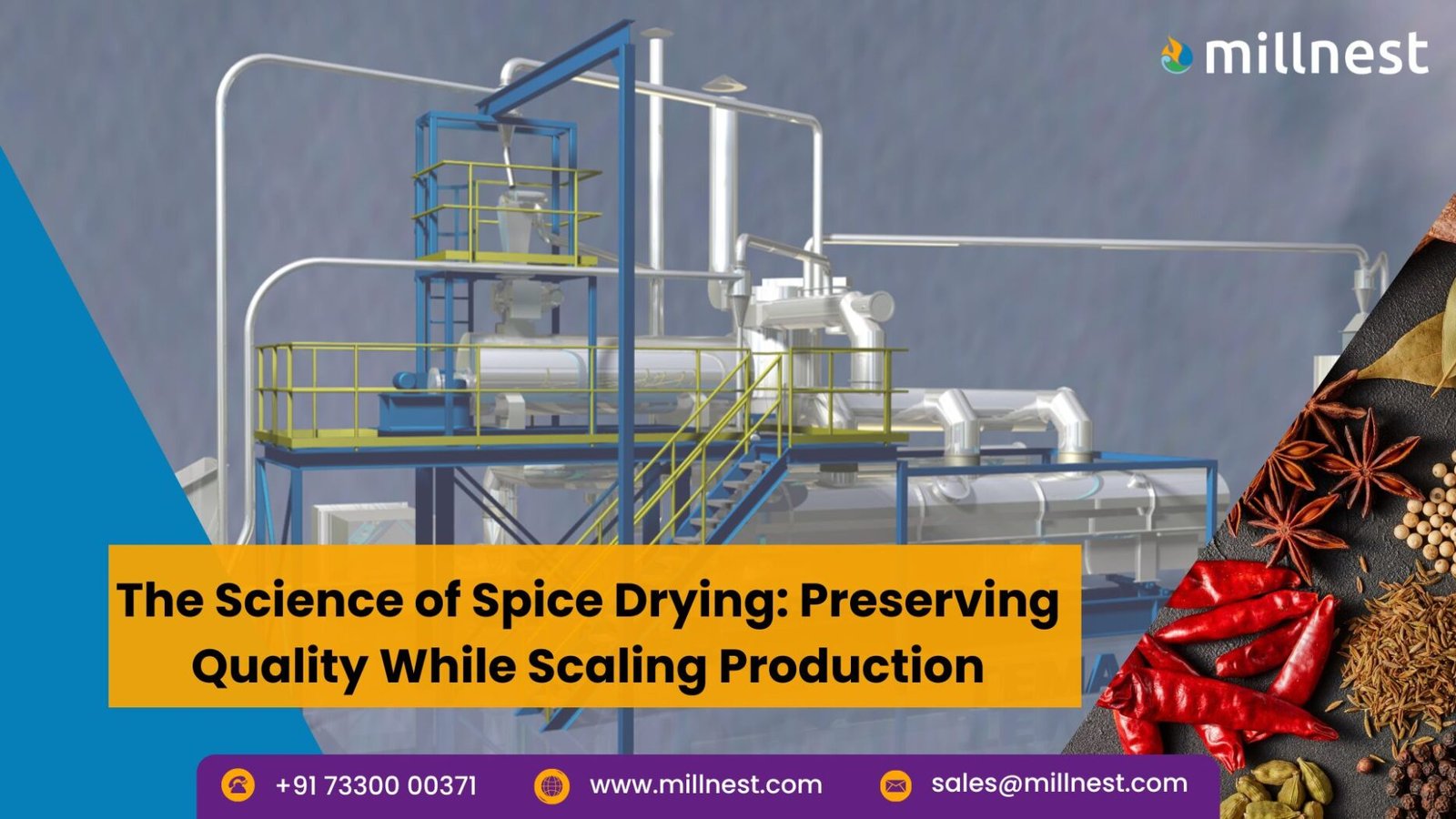
Millnest provides comprehensive drying and cooling technologies designed specifically for spice processing requirements. Understanding the critical balance between moisture removal and quality preservation, Millnest delivers systems that maintain spice integrity while achieving production efficiency.
Advanced Drying Systems: Millnest’s drying equipment incorporates precise temperature control, optimized airflow patterns, and flexible configuration options addressing diverse spice processing needs. Whether handling heat-sensitive aromatics or robust whole spices, the systems maintain quality while ensuring consistent moisture reduction.
Cooling Technology: Recognizing that proper cooling completes the drying process, Millnest provides cooling systems that stabilize dried spices at appropriate temperatures for packaging and storage. These systems prevent moisture reabsorption while efficiently bringing products to ambient conditions.
Custom Solutions: Different spice processors have unique production volumes, facility constraints, and product portfolios. Millnest offers customization ensuring drying and cooling equipment aligns with specific operational requirements rather than forcing compromises with standard configurations.
Energy Efficiency Focus: Understanding energy costs represent significant operational expenses, Millnest designs systems incorporating heat recovery, efficient insulation, and optimized process controls that minimize energy consumption while maintaining drying performance.
Integration Capabilities: Millnest’s drying and cooling solutions integrate seamlessly with other processing equipment including cleaning, grinding, and packaging systems, ensuring smooth material flow and operational continuity throughout the production line.
Technical Support: Beyond equipment supply, Millnest provides ongoing technical support helping processors optimize drying parameters, troubleshoot performance issues, and adapt processes as product requirements evolve.
Achieving Drying Excellence
Perfect spice drying balances scientific understanding with appropriate technology and operational discipline. For processors committed to quality, investing in proper drying systems represents a strategic decision protecting product value, ensuring safety, and enabling efficient scaling.
Millnest’s comprehensive approach to drying and cooling solutions helps spice processors achieve the moisture control precision their products and markets demand.
Ready to optimize your spice drying operations?
Connect with Millnest to explore drying and cooling solutions designed for your specific processing requirements.