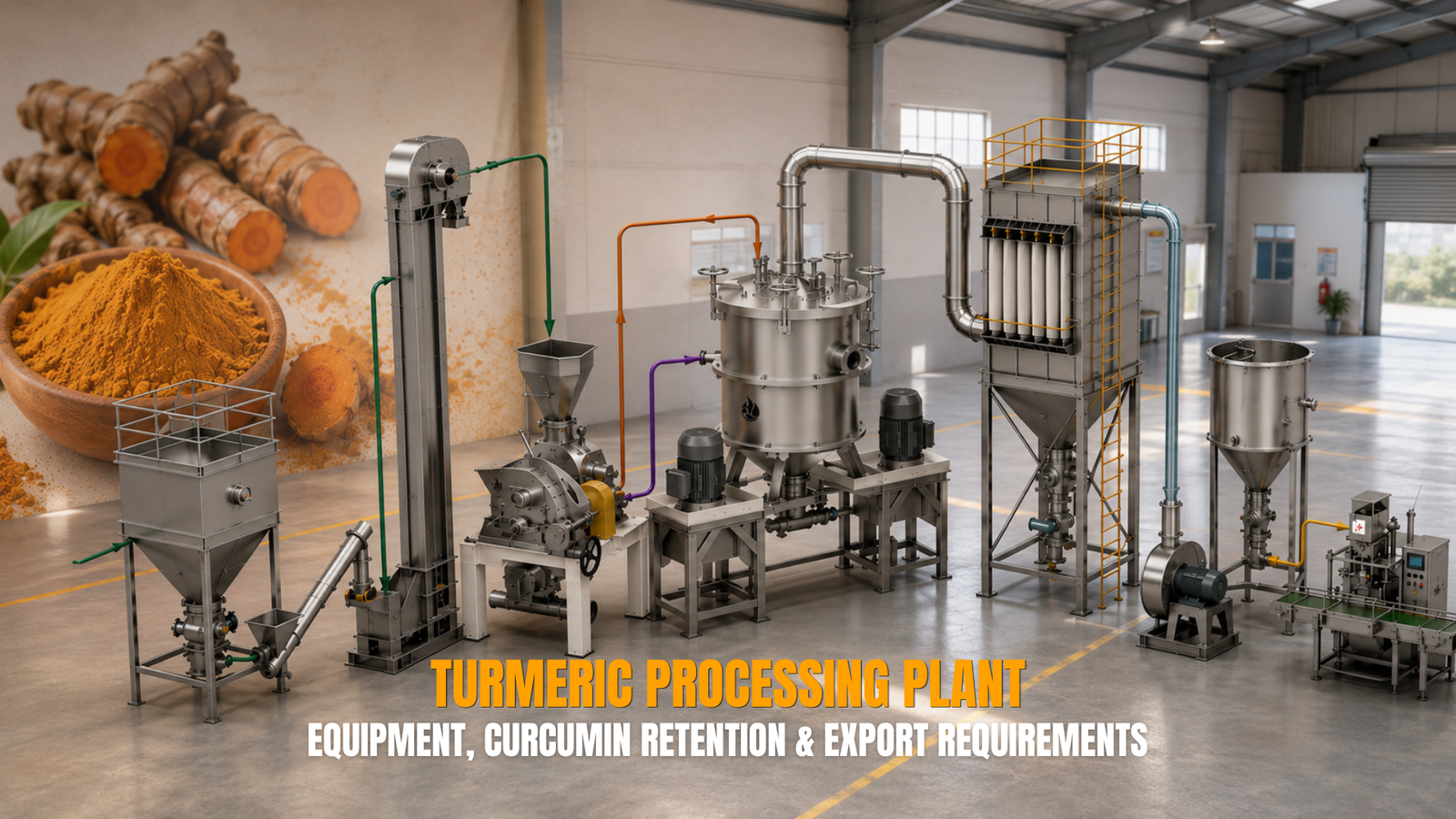
Setting up a turmeric processing plant involves much more than installing a grinding machine and a packing line.
Cured turmeric is a hard, dense rhizome. The raw material can vary in moisture and physical characteristics, fine grinding can introduce heat, and the finished product may need to meet strict requirements for moisture, particle size, microbiological quality, colour and curcuminoid content.
The right equipment therefore depends on what you are producing.
A conventional food-grade turmeric powder does not necessarily require the same process as a fine export-grade powder or turmeric intended for extraction and higher-value ingredient applications.
A well-designed turmeric grinding plant starts with the raw material and works backwards from the finished-product specification.
The Turmeric Processing Line, Stage by Stage
1. Raw Material Cleaning and Inspection
Cured turmeric arrives as whole fingers or bulbs containing soil, stones and other foreign material picked up during harvesting, curing and handling.
Cleaning and inspection should therefore happen before the material enters the milling section.
Destoning is particularly important for a hard rhizome such as turmeric because stones can cause significant damage to grinding components.
Moisture is equally important.
Material with inconsistent or excessive moisture can affect grinding performance, increase product build-up and create problems during storage. MillNest’s turmeric process therefore places moisture control before and after the relevant thermal and milling stages.
For food-grade turmeric powder, FSSAI’s current standard specifies a maximum moisture level of 10% by weight for turmeric powder and requires the product to be free from added colouring matter, including lead chromate.
2. Size Reduction and Kibbling
This is where the original assumption that every turmeric line should begin with a hammer mill needs to be corrected.
Whole cured turmeric fingers are not necessarily suitable as direct feed to a fine Air Classifying Mill.
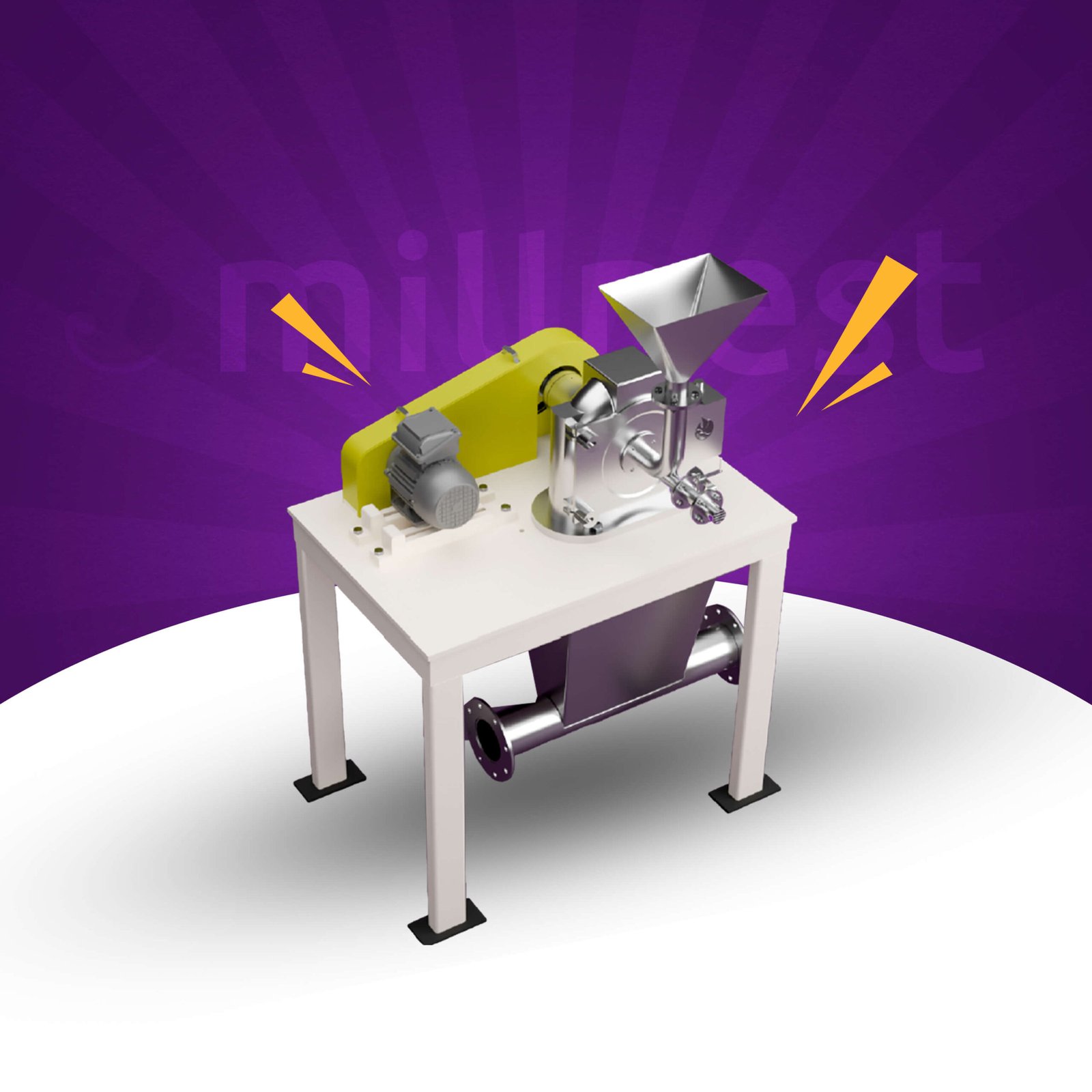
For the MillNest turmeric process, the first milling stage reduces the dried fingers to a controlled kibble size of approximately 2 to 3 mm. MillNest specifies its Universal Mill for this stage, providing the initial size reduction before the fine milling pass.
This approach separates two different jobs.
First stage: reduce the hard rhizome to a consistent feed size.
Second stage: achieve the required fine particle size and distribution.
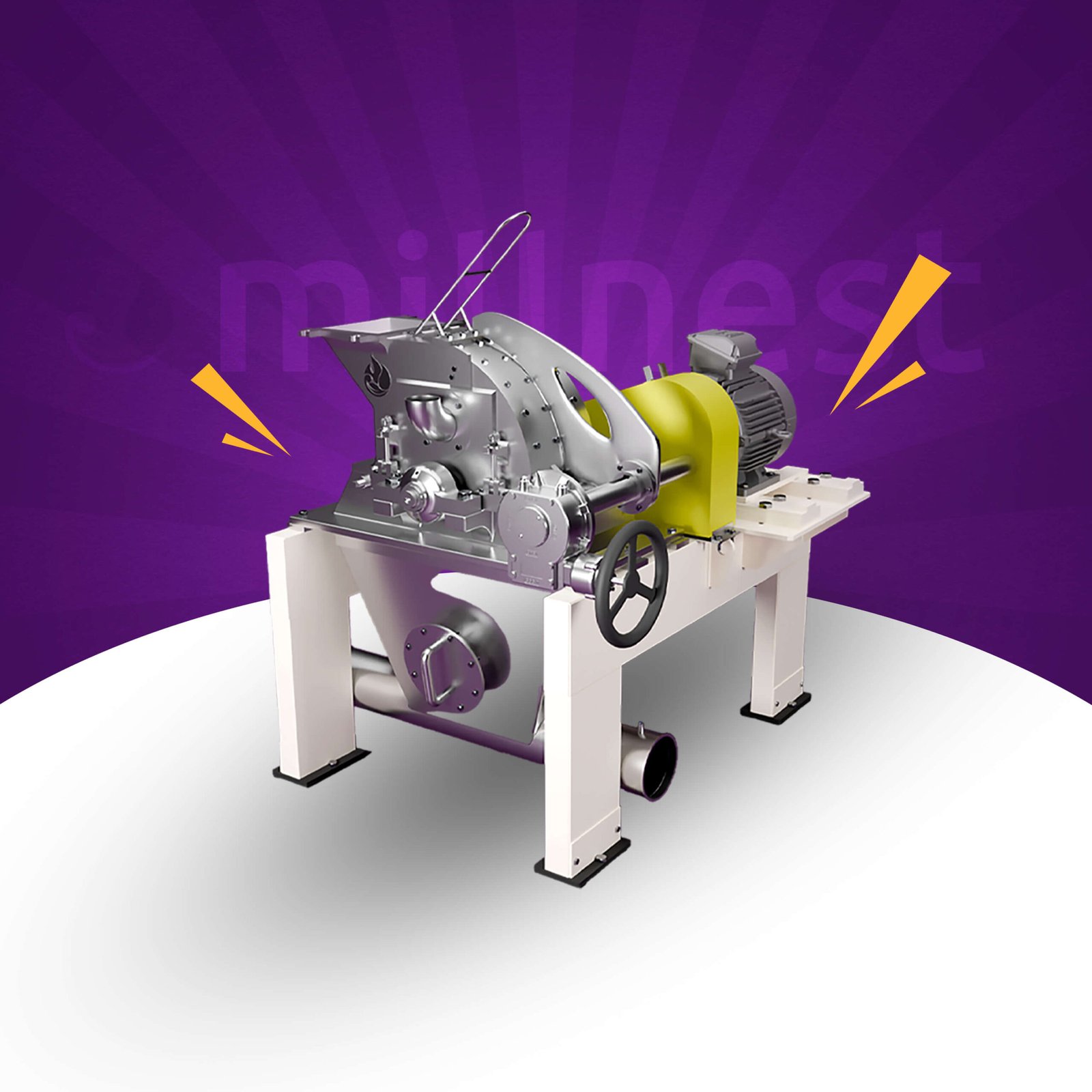
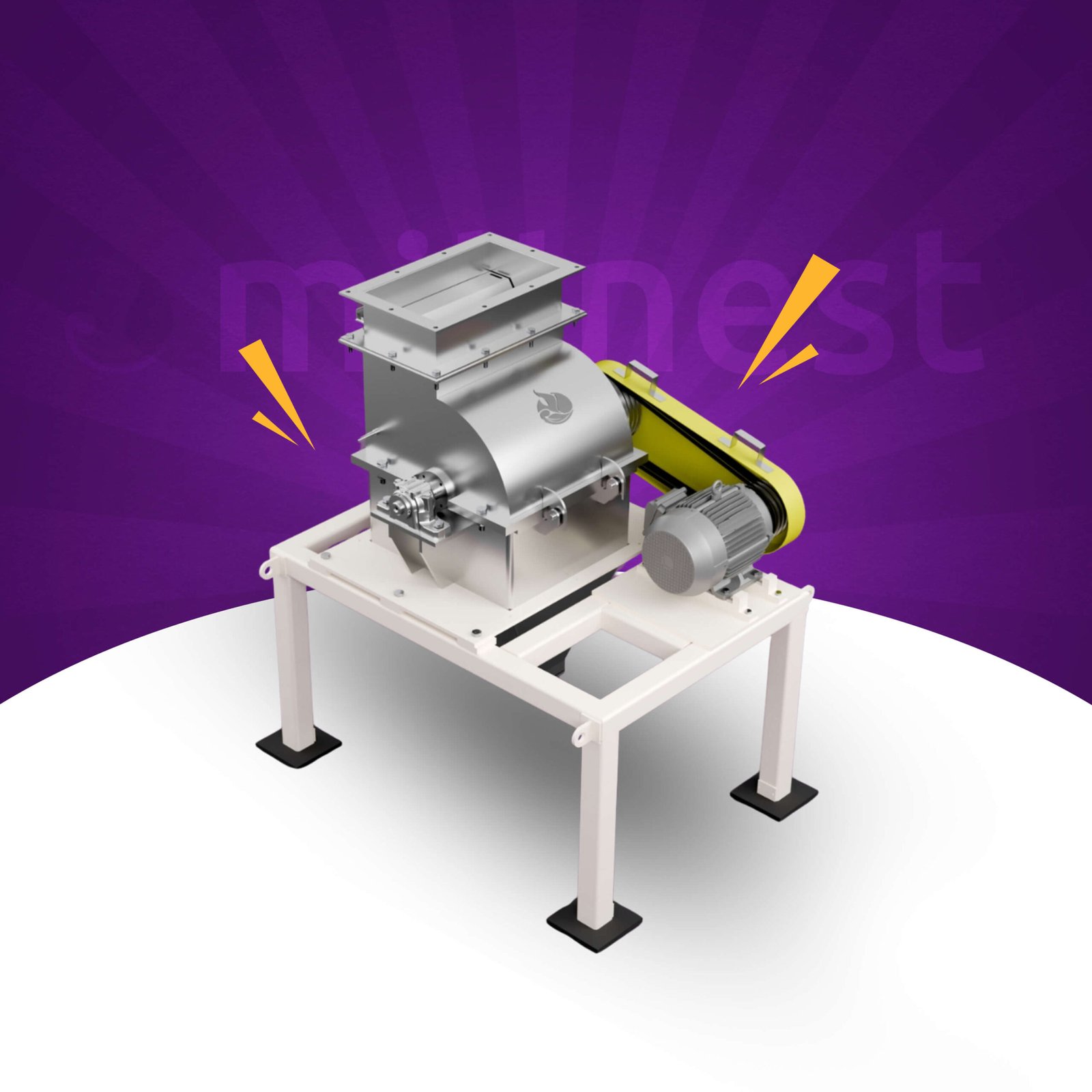
A hammer mill can be suitable for coarse or medium spice grinding applications, including turmeric, but it should not be presented as a mandatory first stage for every turmeric processing plant. MillNest’s MHAM is positioned for screen-controlled size reduction in the approximately 500 micron to 3 mm range, while the MACM is intended for finer, specification-critical milling.
3. Fine Grinding and Air Classification
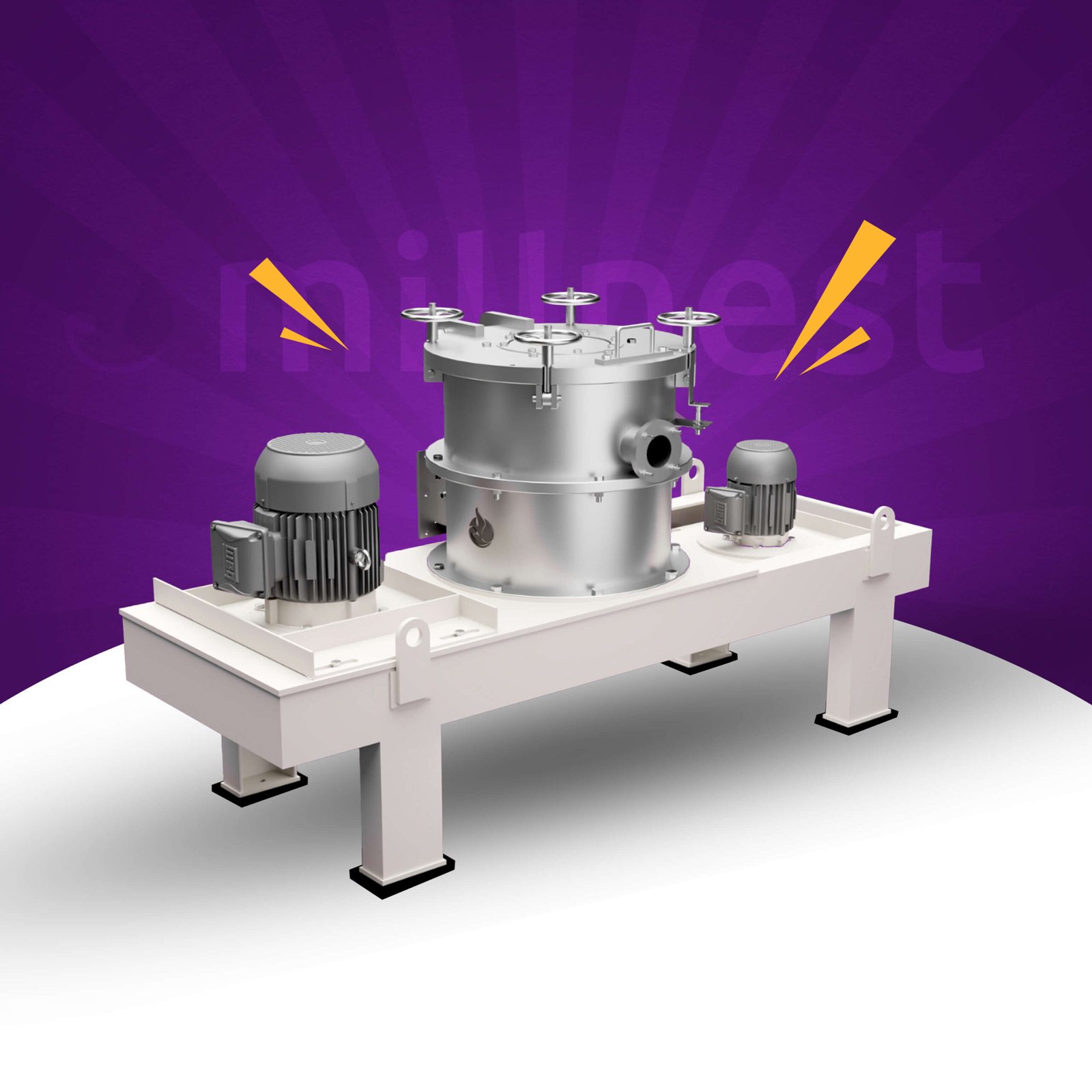
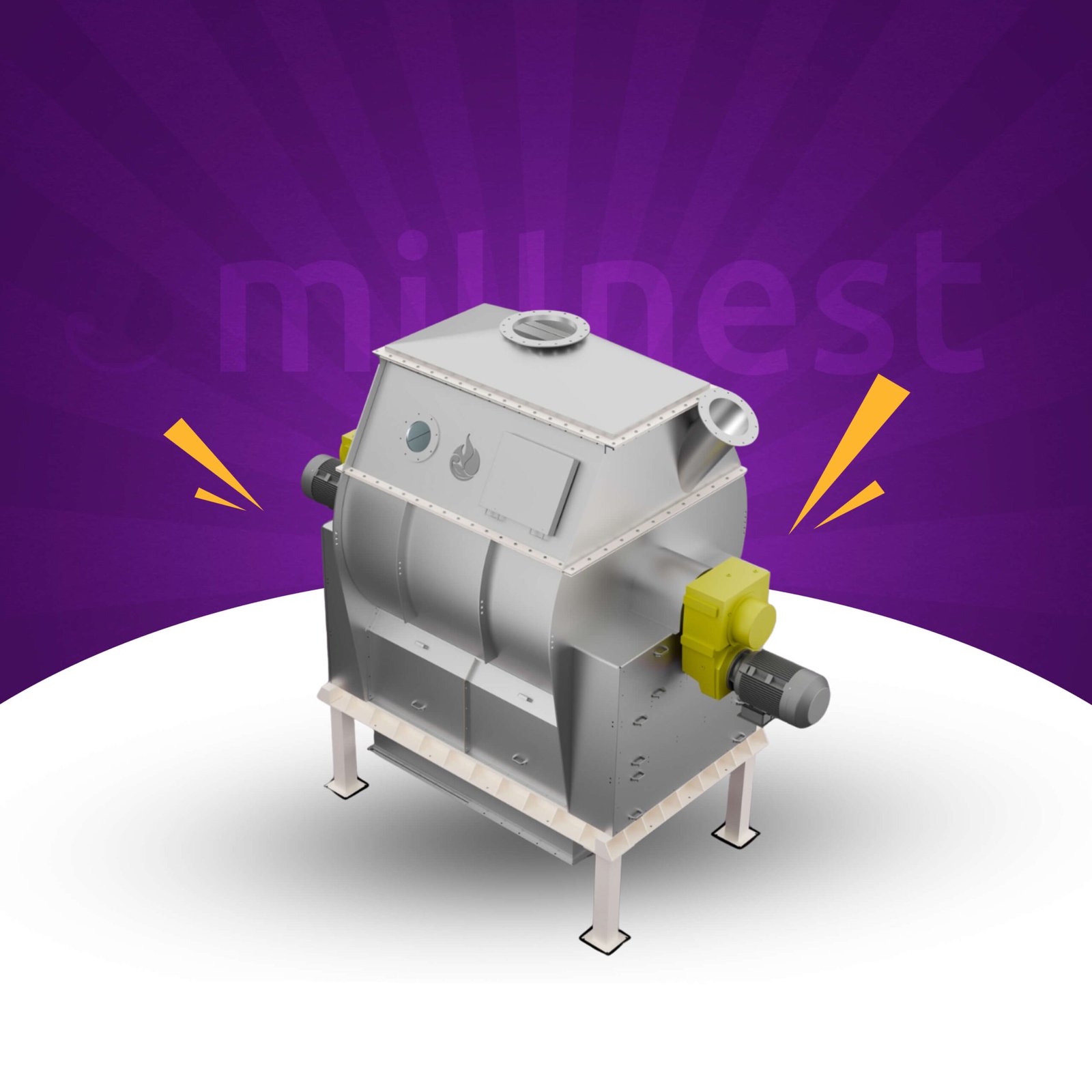
For fine turmeric powder, the Air Classifier Mill becomes the key stage.
The MillNest MACM combines impact grinding and dynamic air classification in one machine. Material is reduced inside the grinding chamber while airflow carries particles towards the classifier. Fine particles meeting the required cut point leave the system, while coarser particles are returned for further grinding.
This provides an important advantage when particle-size consistency matters.
A conventional screen-based system can experience changes in performance as screens wear or become loaded. An integrated classifier provides another way to control the final particle size through classifier operation.
MillNest currently specifies the MACM for D50/D90-sensitive applications and lists turmeric among its fine-grinding applications.
For processors supplying premium food, nutraceutical or other fine-powder applications, this control can be more important than simply achieving a smaller particle size.
4. Managing Temperature During Grinding
Grinding converts mechanical energy into heat.
That makes temperature management an important consideration when processing turmeric, particularly when producing fine powders.
Curcuminoids contribute to turmeric’s characteristic colour and commercial value. The objective of the grinding system should therefore be to achieve the required particle size without creating unnecessary thermal load.
An ACM can support this through its airflow and classification system. The MillNest MACM is designed with in-process air cooling and controlled classification for fine grinding applications.
However, it is important not to make a blanket claim that ACM grinding automatically preserves curcumin.
Actual product temperature depends on feed rate, moisture, machine configuration, airflow, classifier settings, residence time and the properties of the turmeric being processed.
For higher-value applications, these conditions should be established through material trials and validated against the customer’s product specification.
5. Steam Sterilisation for Export-Oriented Processing
Microbiological control is another important part of turmeric processing.
Dried agricultural materials can carry microbial contamination from cultivation, harvesting, drying and handling. Export customers may therefore specify microbiological limits for the finished product.
Where steam sterilisation is required, MillNest offers natural-steam HT-ST technology through its processing solutions.
The current MillNest turmeric process describes treatment at approximately 102–122°C for 20–40 seconds, followed by drying and cooling. The system is intended to provide microbial reduction while maintaining the desired product characteristics under validated operating conditions.
This distinction is important.
HT-ST is a microbial-control step. It is not a solution for chemical adulteration such as lead chromate.
The required treatment conditions should be established and validated for the product, process and target microbiological specification.
6. Drying and Cooling After Sterilisation
Steam treatment introduces moisture into the product.
That makes post-sterilisation drying and cooling an important part of the process rather than an optional add-on.
MillNest’s turmeric process incorporates a Fluid Bed Dryer after HT-ST treatment to restore the material towards the required moisture condition before subsequent processing.
Uniform drying is particularly important because an average moisture value can hide variations within a batch.
The objective is to achieve consistent moisture throughout the material before fine grinding and packing.
7. Dust Collection and Product Recovery
Turmeric grinding generates fine particulate matter.
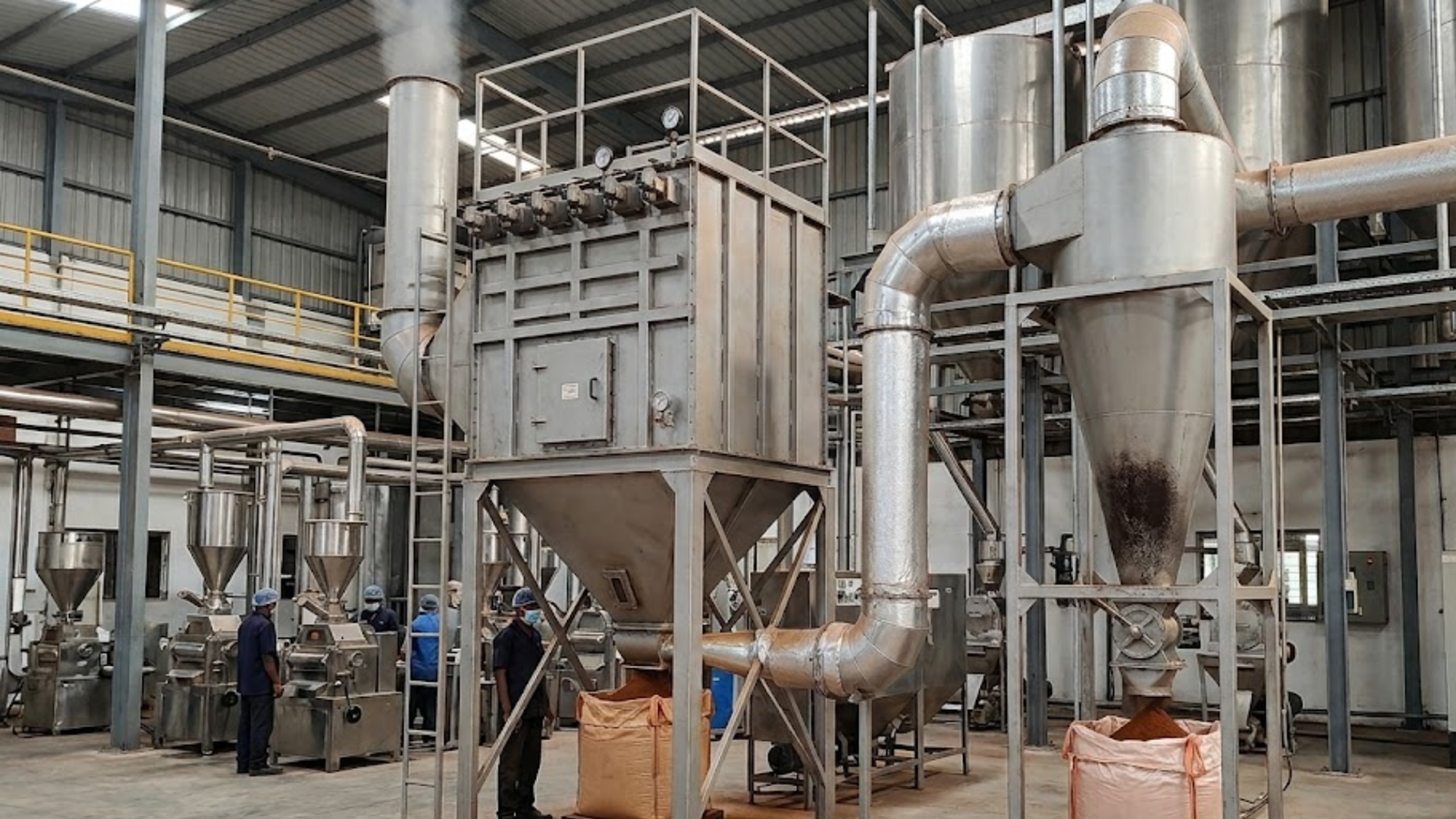
A properly designed dust collection system helps control airborne dust around the processing equipment while recovering product that would otherwise be lost.
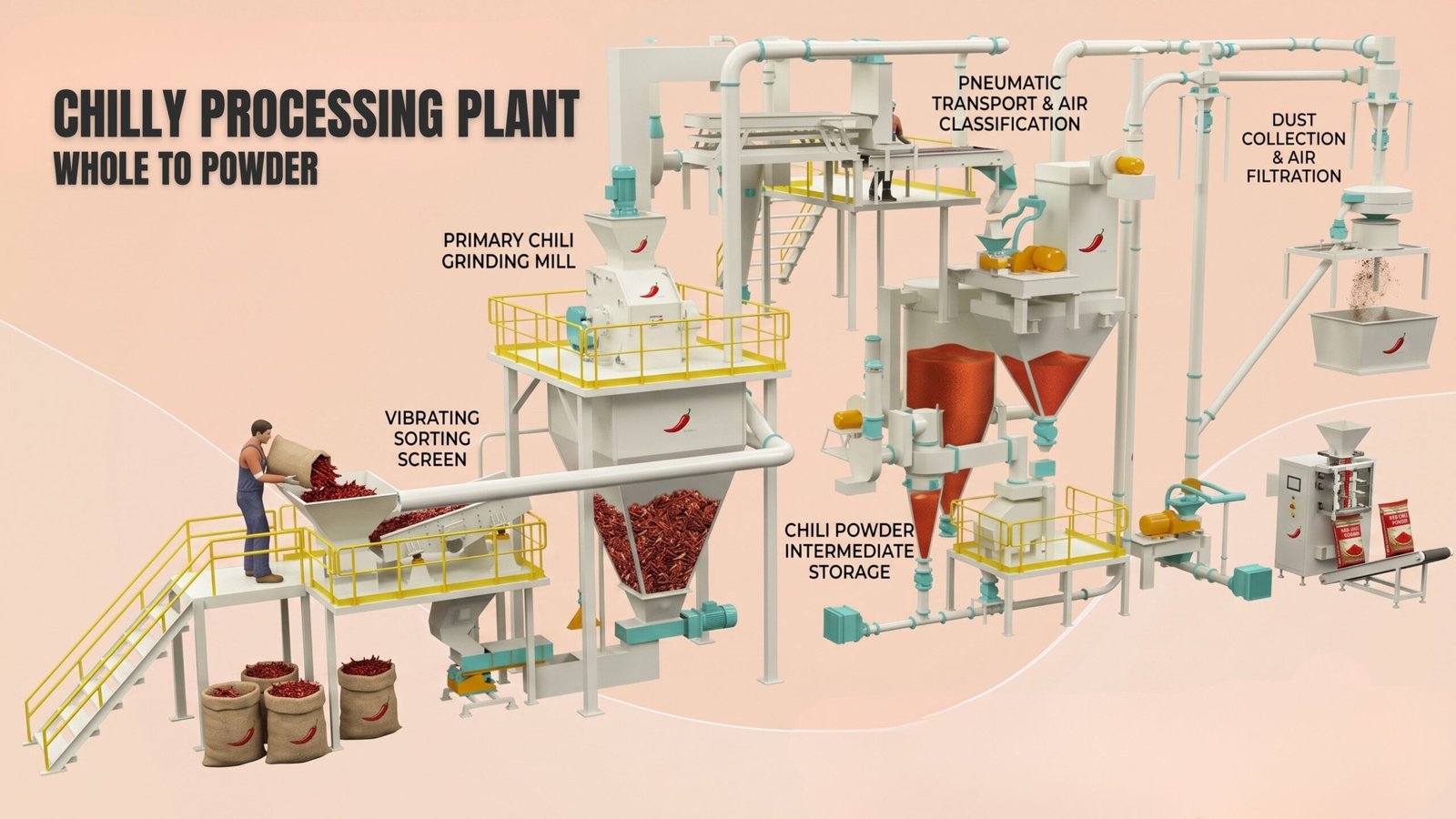
Cyclones, bag filters and appropriate air-handling equipment can be integrated into the line according to the process configuration.
Dust collection is therefore both a workplace and product-recovery consideration.
A clean, controlled grinding environment also makes housekeeping, maintenance and routine inspection easier.
8. Delumping and Powder Handling
Fine turmeric powder can form agglomerates during storage and handling.
This does not necessarily mean that the grinding process has failed.
If the product has already achieved its required particle size, sending the entire stream back through a fine mill simply to break storage lumps can introduce unnecessary processing.
A delumper can break agglomerates and restore free-flowing powder without deliberately reducing the particle size again.
MillNest’s Delumper range is designed for this type of powder-handling application, including hygroscopic spice powders.
Equipment Selection Guide
The right equipment depends on the target product.
Universal Mill
Best suited to: controlled initial size reduction and applications requiring flexible impact, shear or attrition milling.
For the MillNest turmeric process, the Universal Mill can reduce dried turmeric fingers to a controlled kibble size before fine milling.
Air Classifier Mill
Best suited to: fine turmeric powder and applications where particle-size distribution needs tighter control.
The MACM combines grinding and classification in one system and is the primary fine-milling option in MillNest’s turmeric process.
Hammer Mill
Best suited to: coarse-to-medium size reduction and applications where screen-controlled particle size is appropriate.
The MHAM remains relevant to turmeric and other spice applications, but it should be selected according to the required output rather than presented as a mandatory first stage of every turmeric line.
Natural Steam Sterilizer
Best suited to: microbial reduction where the customer’s specification and validated process require steam treatment.
Fluid Bed Dryer
Best suited to: moisture restoration and controlled drying or cooling, including post-sterilisation processing.
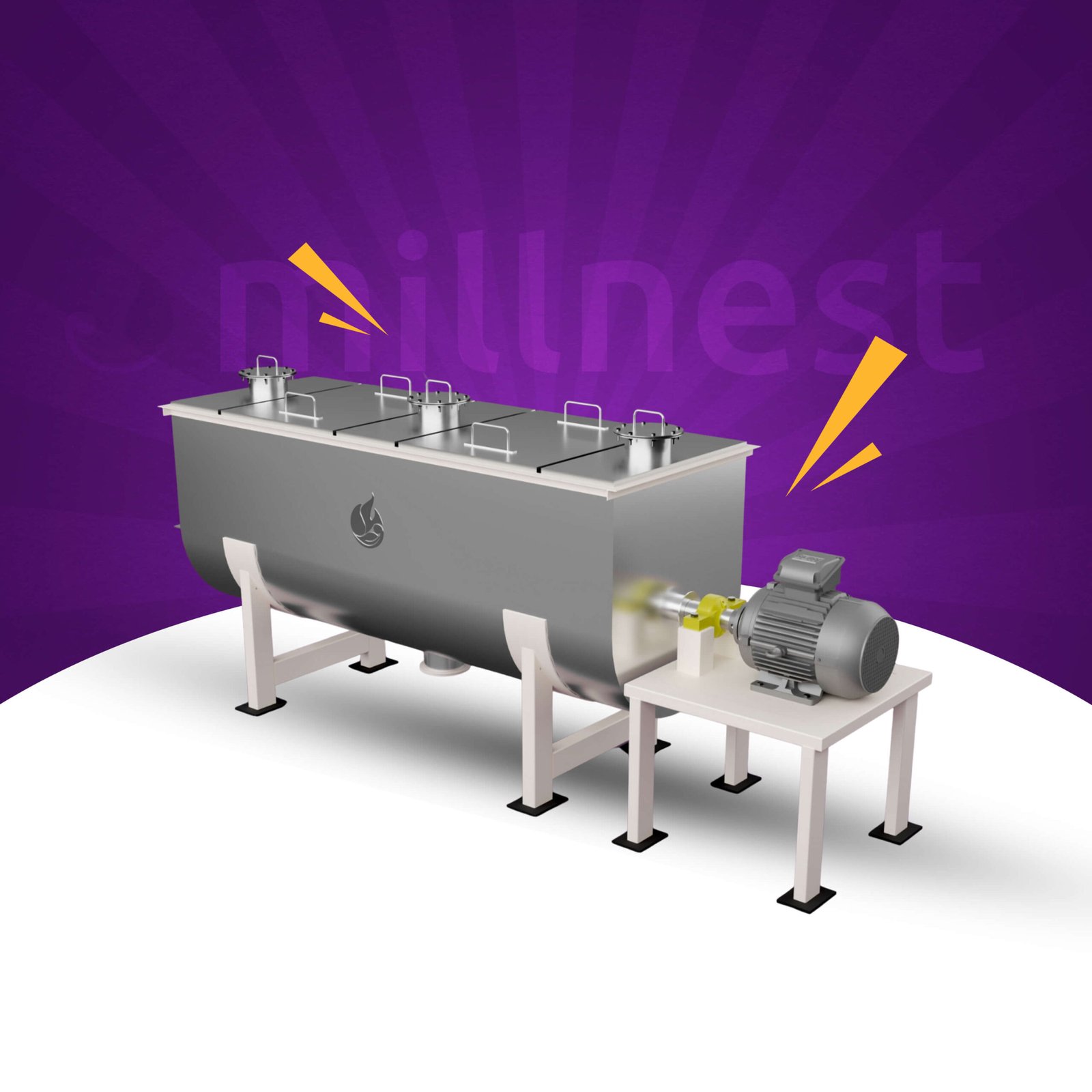
Delumper
Best suited to: breaking powder agglomerates after grinding or during storage and handling.
Designing a Turmeric Processing Plant for Export
Export-oriented turmeric processing needs to consider more than grinding.
Typical quality requirements can include:
- Moisture
- Particle size
- Curcuminoid or colour specification
- Microbiological parameters
- Foreign material
- Adulteration controls
- Batch traceability
- Packaging and labelling requirements
For example, India’s FSSAI standard for turmeric powder specifies that the product must be free from added colouring matter including lead chromate and sets requirements including moisture, ash, insoluble ash, curcuminoid content and starch.
FSSAI also maintains a specific analytical method for detecting lead chromate in turmeric powder.
This illustrates an important principle:
Equipment supports compliance. It does not replace testing or a food-safety management system.
A closed and controlled processing line can reduce unnecessary product exposure and improve traceability, but incoming raw material still needs appropriate supplier controls and testing.
What Changes for Higher-Value Applications?
Turmeric intended for nutraceutical, pharmaceutical or extraction applications can require tighter control over particle size, microbiological quality, moisture and processing conditions.
However, it is important to distinguish turmeric powder from curcumin extract.
Grinding turmeric does not produce pharmaceutical-grade curcumin by itself.
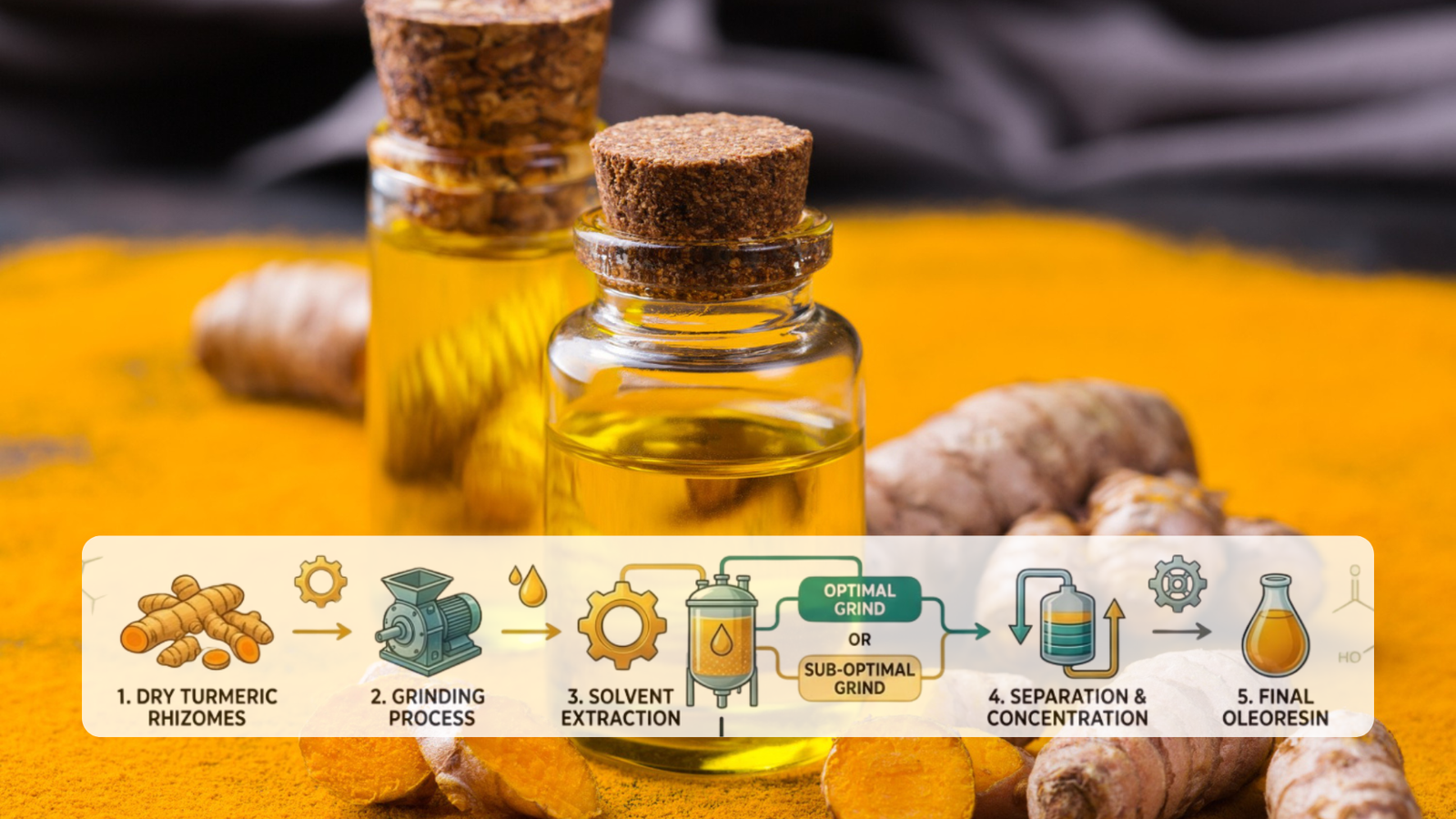
Where the objective is curcuminoid or oleoresin extraction, the grinding stage prepares the turmeric for the downstream extraction process. The appropriate particle size should therefore be determined by the extraction technology rather than assuming that the finest possible powder is always best.
MillNest also offers turmeric oleoresin processing solutions where controlled size reduction and steam sterilisation are integrated with downstream extraction requirements.
Planning Your Turmeric Processing Plant
The starting point should always be the finished-product specification.
Before selecting equipment, establish:
What is the incoming turmeric feed size?
What is the moisture range?
What final particle size is required?
What throughput is expected?
Is the product intended for domestic food, export, nutraceutical or extraction applications?
Is steam sterilisation required?
What quality parameters must be demonstrated for each batch?
Once these requirements are defined, the equipment configuration becomes much clearer.
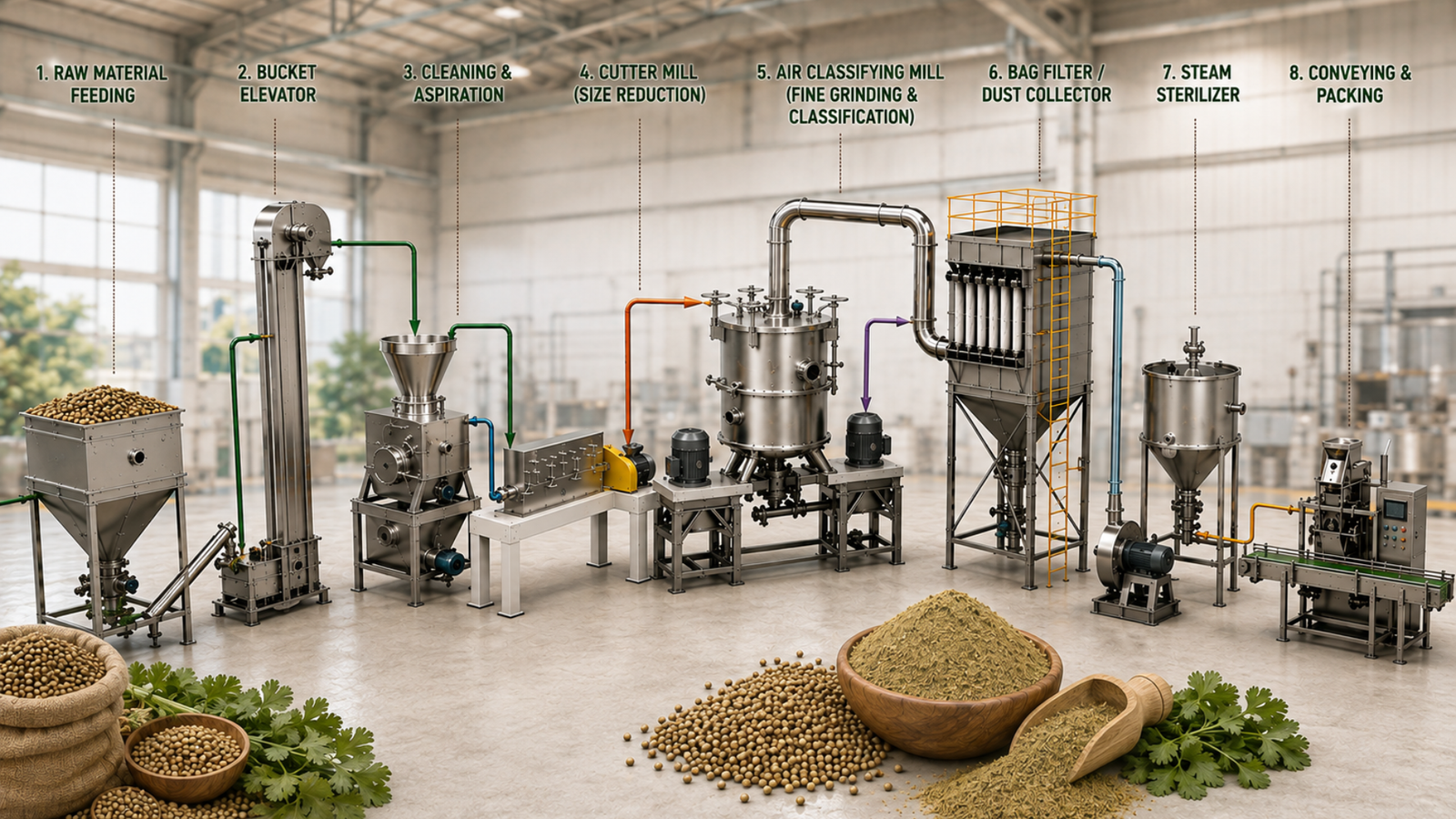
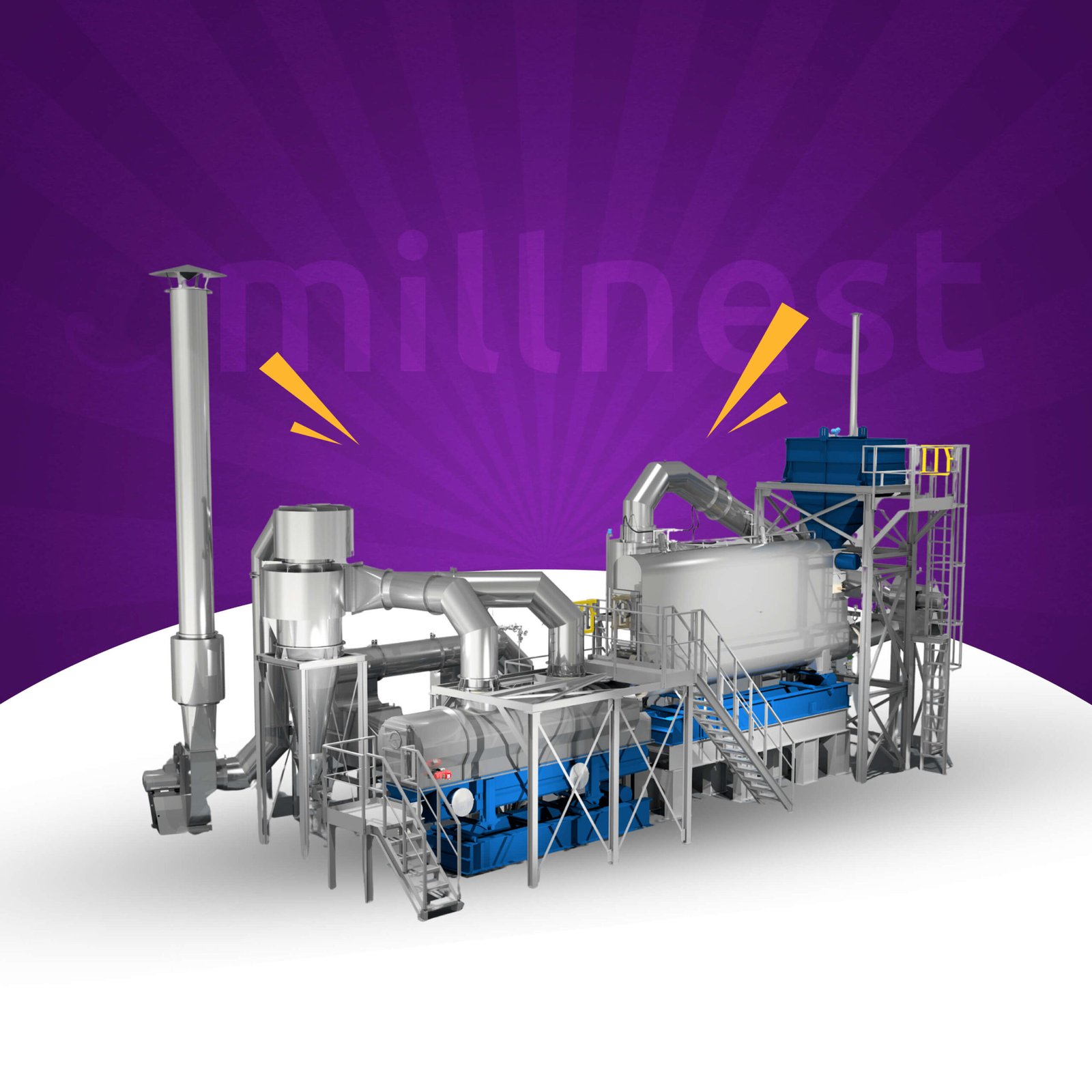
A typical fine-powder MillNest turmeric process can be structured around:
Raw Material Receipt & Cleaning
↓
Controlled Size Reduction / Kibbling
↓
Pneumatic Conveying
↓
Air Classifier Mill
↓
Dust Collection
↓
Product Collection
↓
Delumping, if required
↓
Packing
Where export microbial requirements apply, the process can incorporate:
Cleaning → HT-ST Sterilisation → Drying & Cooling → Size Reduction → Fine Grinding & Classification → Packing
The exact sequence depends on the raw material, target grade and customer requirements.
Common Questions About Turmeric Processing
What is the best machine for grinding turmeric?
There is no single answer.
For initial size reduction, a Universal Mill or Hammer Mill may be appropriate depending on feed size and required output. For fine turmeric powder where particle-size distribution is critical, an Air Classifier Mill can combine grinding and classification in one system.
Does turmeric always need a hammer mill before an ACM?
No.
The configuration depends on the feed size and final specification. In MillNest’s current turmeric process, the Universal Mill performs the initial kibbling stage before the material is conveyed to the ACM for fine grinding and classification.
How do you protect curcumin during grinding?
The process should be designed to control temperature and avoid unnecessary residence time or overgrinding. Feed moisture, feed rate, airflow, classifier settings and mill configuration all matter. For demanding applications, actual product trials and temperature measurements should establish the operating window.
Does turmeric require steam sterilisation for export?
Not every export destination or customer has the same processing requirement. Microbiological specifications should be established from the target market and customer requirements. Where steam sterilisation is selected, the treatment needs to be validated against the required microbial reduction.
Why does turmeric cake after grinding?
Fine turmeric powder can agglomerate during storage and handling. Moisture control and appropriate handling are important. A delumper can break agglomerates without deliberately regrinding the finished powder.
What does a turmeric processing plant cost?
There is no meaningful single price.
Capacity, raw-material preparation, milling technology, sterilisation, drying, dust collection, automation, packing and the required level of process integration all affect the investment.
The more reliable starting point is a material trial and a process design based on your actual turmeric, target product and throughput.
Building the Right Turmeric Processing Line
A successful turmeric processing plant is not defined by the number of machines installed.
It is defined by how well the equipment works together to meet the finished-product specification.
The first stage prepares the hard rhizome.
The fine-milling stage establishes the required powder characteristics.
The classifier controls the particle-size distribution.
Air handling and dust collection support a cleaner process.
Sterilisation and drying address microbial and moisture requirements where specified.
Delumping protects powder flow after grinding.
Traceability and testing provide the evidence that the finished product meets the required specification.
For processors looking at a turmeric grinding plant, the most important decision is therefore not simply choosing the most powerful mill.
It is choosing the right process.
At MillNest, turmeric processing solutions can be configured around the raw material, required particle size, throughput and target market, with material trials used to establish the appropriate equipment combination before the final investment decision.